
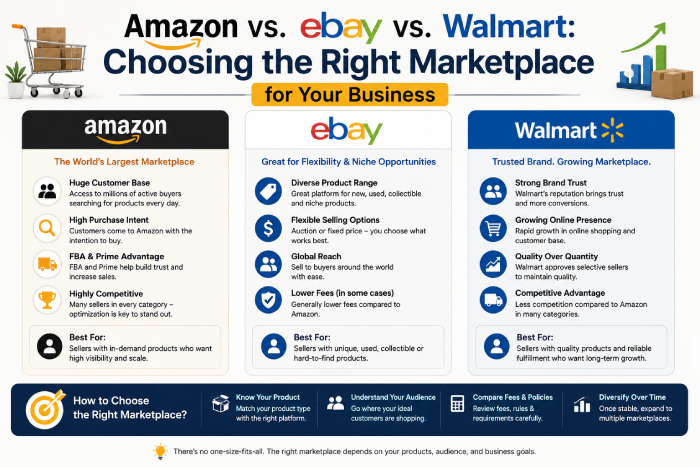
Choosing the right marketplace can have a major impact on the growth of an eCommerce business. Amazon, eBay, and Walmart each provide access to large customer audiences, but they operate differently and attract different types of shoppers.
Instead of asking which marketplace is universally the best, sellers should consider which platform aligns with their products, customers, pricing strategy, and business goals.
Amazon
Amazon is one of the largest eCommerce marketplaces and provides sellers with access to millions of potential customers.
One of its biggest advantages is customer demand. Shoppers often visit Amazon with the intention of purchasing a specific product, which can create strong opportunities for sellers with competitive products and well-optimized listings.
Success on Amazon requires attention to product titles, keywords, images, pricing, reviews, inventory, and fulfillment.
Competition can also be intense. Sellers need to continuously monitor competitors and improve their listings to remain competitive.
eBay
eBay provides sellers with a flexible marketplace that supports both new and used products, collectibles, specialized items, and many other categories.
Its marketplace model can be particularly useful for businesses that want flexibility in how products are listed and sold.
Strong product descriptions, accurate information, competitive pricing, and high-quality images can help sellers attract buyers.
Because eBay has a broad range of product categories, sellers can find opportunities in specialized niches that may be more difficult to compete in elsewhere.
Walmart Marketplace
Walmart Marketplace provides businesses with another opportunity to reach online shoppers through a well-established retail brand.
For sellers with competitive products, reliable fulfillment, and strong operational processes, Walmart can become an important additional sales channel.
Businesses considering Walmart should carefully review marketplace requirements and make sure their inventory, shipping, customer service, and product information are prepared to meet expectations.
Which Marketplace Should You Choose?
The right choice depends on your business model.
If your products have strong search demand and you want access to a massive marketplace audience, Amazon may be an attractive option.
If you sell specialized products or want a flexible marketplace environment, eBay may provide strong opportunities.
If you already have reliable operations and want to expand into another major retail marketplace, Walmart may be worth considering.
You also do not necessarily need to choose only one platform.
Consider a Multi-Marketplace Strategy
Once your business has established reliable processes, expanding to multiple marketplaces can help diversify revenue and reduce dependence on a single platform.
However, expansion should be strategic. Managing several marketplaces requires effective inventory management, consistent product information, reliable fulfillment, and strong customer support.
Start with one platform, understand what works, optimize your operations, and then expand when your business is ready.
Final Thoughts
There is no single marketplace that is perfect for every seller. The best platform depends on your products, customers, competition, operational capabilities, and long-term goals.
By understanding the strengths of Amazon, eBay, and Walmart and creating a strategy around your specific business, you can make more informed decisions and build a stronger foundation for eCommerce growth.